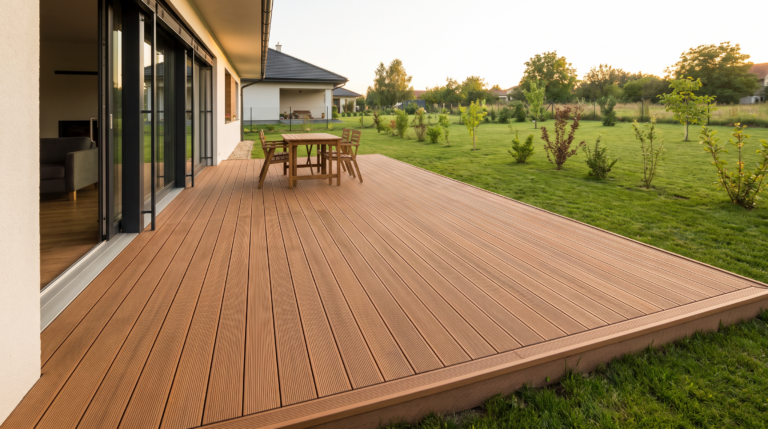

A terrace extends your home’s living space into the garden, allowing you to relax and entertain outdoors more comfortably. You may already have your own outdoor terrace or be planning to build one.
Safety is always a top priority when you are outdoors. When searching for the best materials for building a terrace, you might ask: are composite decking boards slippery when wet?
Any outdoor material can become slippery when wet, but by choosing the right brand, style or installation method, you can prevent slips and falls. In this article, we will explain why composite decking boards can be slippery and how you can avoid it.
Why are decking boards slippery?
There are many reasons why boards can feel slightly slippery when walking on a terrace. One possible cause is lower-quality composite material, which may lead to your composite flooring being slippery.
1. No texture on the surface of the board
In everyday life, the coefficient of friction differs between a smooth surface and a textured surface. This also applies to outdoor terraces. Composite board surfaces usually feature a solid wood texture, which can increase the coefficient of friction.
In other words, composite board manufacturers add wood fibres or grooves to the surface of the board to enhance anti-slip safety on the terrace when wet.
If you purchase composite boards that lack a non-slip surface texture, or if these textures have worn down after years of use, the composite boards will become slippery when it rains or snows.
2. Debris and dirt
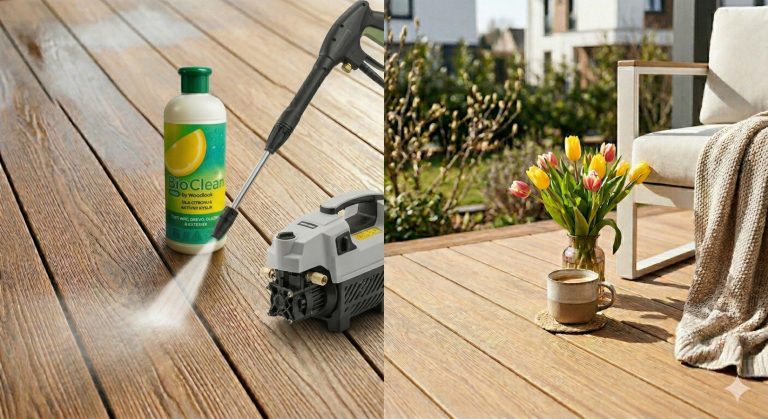
Debris such as leaves, dirt or other grime can accumulate on composite decking boards. Although composite boards have high resistance to mould, failing to clean off this debris in time can lead to mould or algae growth, making the surface of the board slippery.
If the terrace surface is kept clean, fungi or organic growth are much less likely to form on terrace surfaces.
3. Snow or ice
When it snows or freezes, everything becomes slippery, even composite boards with a non-slip surface. It is therefore important to remove all snow from the boards once it stops snowing. When clearing snow from the boards, it is essential to use a shovel that is not made of metal. This prevents damaging the board surface with sharp, rigid tools. If there is a solid frozen layer on the board, do not attempt to scrape it off, as this could ruin the terrace boards.
How to prevent slippery composite boards?
1. Choose a textured board
If you live in an area with high humidity or frequent rainfall, choose composite boards with a wood grain pattern or grooves. Having distinct textures on the surface will prevent slipping easily, whether it is wet or dry outside.
2. Preventing water damage
When people ask: “Is composite flooring slippery when wet?”, they want to know whether rain will make the composite terrace surface very slippery. Since composite material is resistant to water and moisture, rainwater tends to pool on the surface of the terrace.
So when standing water pools on composite decking boards, simply use a broom to sweep away the excess water.
3. Proper installation of boards
Proper installation of a WPC terrace means leaving gaps between the boards for drainage. This prevents water from pooling on the terrace. Some terraces have a drainage system built underneath that drains water away from the base of the house.